Bounding boxes
Object extents for detection tasks, with agreed rules for truncation, overlap and partially visible objects.
COMPUTER VISION / ANNOTATION
Image and video annotation guided by explicit object definitions, boundary rules and frame-to-frame consistency. Start with a sample that makes the requirements concrete.
12+ years of relevant professional experience · Direct founder involvement
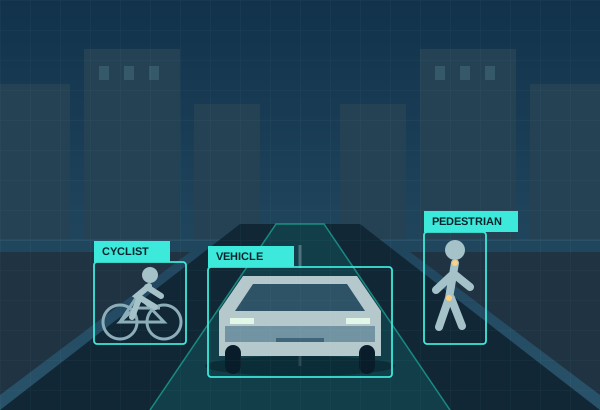
IMAGE & VIDEO CAPABILITIES
Annotation translates a visual specification into structured observations. Clear taxonomies and explicit edge-case rules help make labels easier to review and use.
Object extents for detection tasks, with agreed rules for truncation, overlap and partially visible objects.
Object outlines and class regions, with boundary and inclusion rules defined for the task.
Points following a specified schema, with visibility and ambiguity handling agreed in advance.
Persistent identity across selected frames, with review of re-entry, occlusion and identity changes.
Checks for label drift, missed objects and inconsistent interpretation across a sequence.
A representative sample to clarify classes and edge cases before committing to a larger scope.
SYNTHETIC WORKSPACE
Switch between illustrative annotation types. The vector scene is original; it contains no client imagery and no measured performance results.
Box placement follows the agreed object-inclusion rules. This example identifies vehicles and pedestrians.
Simplified frame pair: the same ID follows the same object. Frame-to-frame review also checks visibility, class and boundary changes.
WHAT YOU RECEIVE
Final scope, tools and export requirements are confirmed before work starts. The items below describe proposed deliverable types, not a promise of every format or integration.
Labels prepared to the agreed taxonomy. Required tools and export compatibility are assessed before acceptance.
Decisions on ambiguous objects, visibility, boundaries and class definitions recorded for review.
Observations, flagged cases and correction notes for the agreed review scope.
QUALITY BY DESIGN
A focused pilot helps establish the task rules, review method and acceptance criteria. No generic accuracy promise replaces a task-specific agreement.
Agree on classes, object boundaries, visibility flags and sequence rules.
Annotate a representative sample with the proposed specification.
Resolve ambiguous cases and inspect labels against agreed criteria.
Provide the agreed annotations and supporting review notes.
PROJECT QUESTIONS
Scope and suitability are reviewed directly with the founder.
Yes, the initial discussion can start from your guidelines. A pilot helps identify ambiguities and assess whether the task, tools and timeline are a suitable fit.
Relevant experience includes CVAT and Roboflow. Specific access, workflow and export requirements must be checked before a delivery commitment; universal format support is not promised.
The specification should state whether to include visible extent, inferred extent or a flag for uncertainty. These choices are agreed for the task rather than assumed.
Volume, frame sampling, annotation complexity and review needs are assessed against current capacity. Altema does not claim an in-house production workforce or unlimited throughput.
START WITH A CLEAR SCOPE
Independent, founder-led delivery. Capacity, timing and requirements are assessed for each project.